
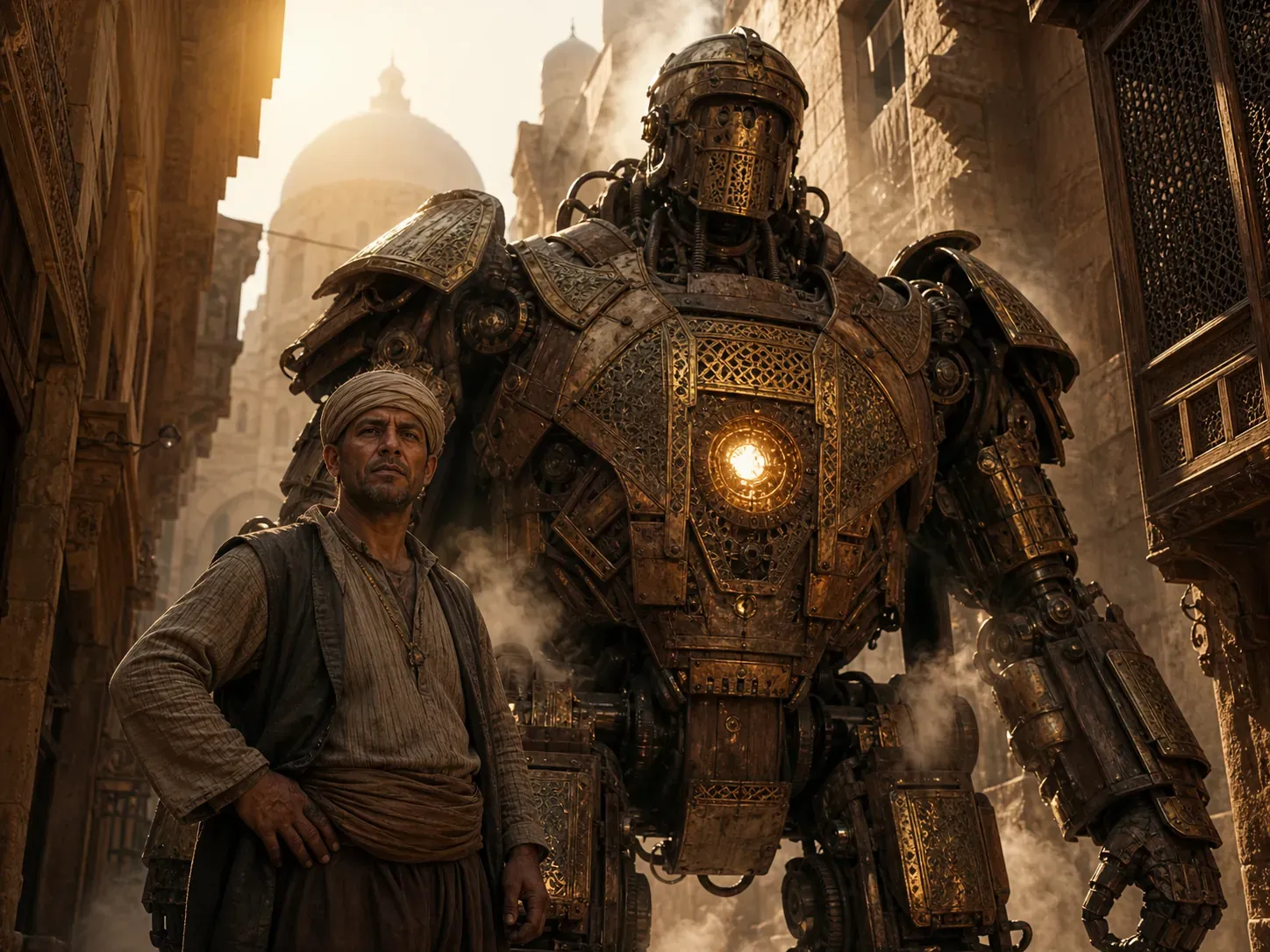
Tutorial: The Cairo Beans Cart Transformer
٨/٨/٢٠٢٦
A complete, reproducible production walkthrough — from character sheets to a final Seedance 2.0 video prompt.
درس إنتاجي كامل قابل لإعادة التطبيق — من أوراق الشخصيات حتى البرومبت النهائي لفيديو Seedance 2.0.
1. Overview / نظرة عامة
EN — In this tutorial we build one of the most cinematic GenAI shots possible: an authentic Egyptian fuul (fava beans) street cart in medieval Islamic Cairo that transforms into a monumental mechanical guardian. We treat GenAI as a craft medium. We do not type one giant prompt and hope. We work in disciplined layers: (1) lock the character of the vendor, (2) lock the transformer design, (3) lock the environment, then (4) feed all three as references into a single structured Seedance 2.0 prompt.
ع — في هذا الدرس نبني واحدة من أكثر اللقطات سينمائية في الذكاء الاصطناعي التوليدي: عربة فول مصرية أصيلة في قاهرة العصور الوسطى الإسلامية، تتحول إلى حارس آلي عملاق. نتعامل مع الذكاء الاصطناعي كوسيط حرفي. لا نكتب برومبت واحد ضخم ونأمل في النتيجة، بل نعمل بطبقات منضبطة: (1) تثبيت شخصية البائع، (2) تثبيت تصميم المتحول، (3) تثبيت البيئة، ثم (4) إدخال الثلاثة كمراجع داخل برومبت Seedance 2.0 منظم واحد.
The four-asset / الأصول الأربعة
# | Asset / الأصل | Tool / الأداة | Output / الناتج |
|---|---|---|---|
1 | Vendor character sheet / ورقة شخصية البائع | GPT Image 2 |
|
2 | Transformer design sheet / ورقة تصميم المتحول | GPT Image 2 |
|
3 | Environment sheet / ورقة البيئة | GPT Image 2 |
|
4 | Final video / الفيديو النهائي | Seedance 2.0 |
|
2. Step by Step / خطوة بخطوة
EN — Follow these in order. Each step locks one variable so the next has a stable foundation. This is the single biggest difference between amateur and professional GenAI work: isolate, lock, then combine.
ع — اتبع الخطوات بالترتيب. كل خطوة تثبّت متغيراً واحداً لتبني الخطوة التالية على أساس ثابت. هذا هو الفارق الأكبر بين العمل الهاوي والاحترافي في الذكاء الاصطناعي: اعزل، ثبّت، ثم ادمج.
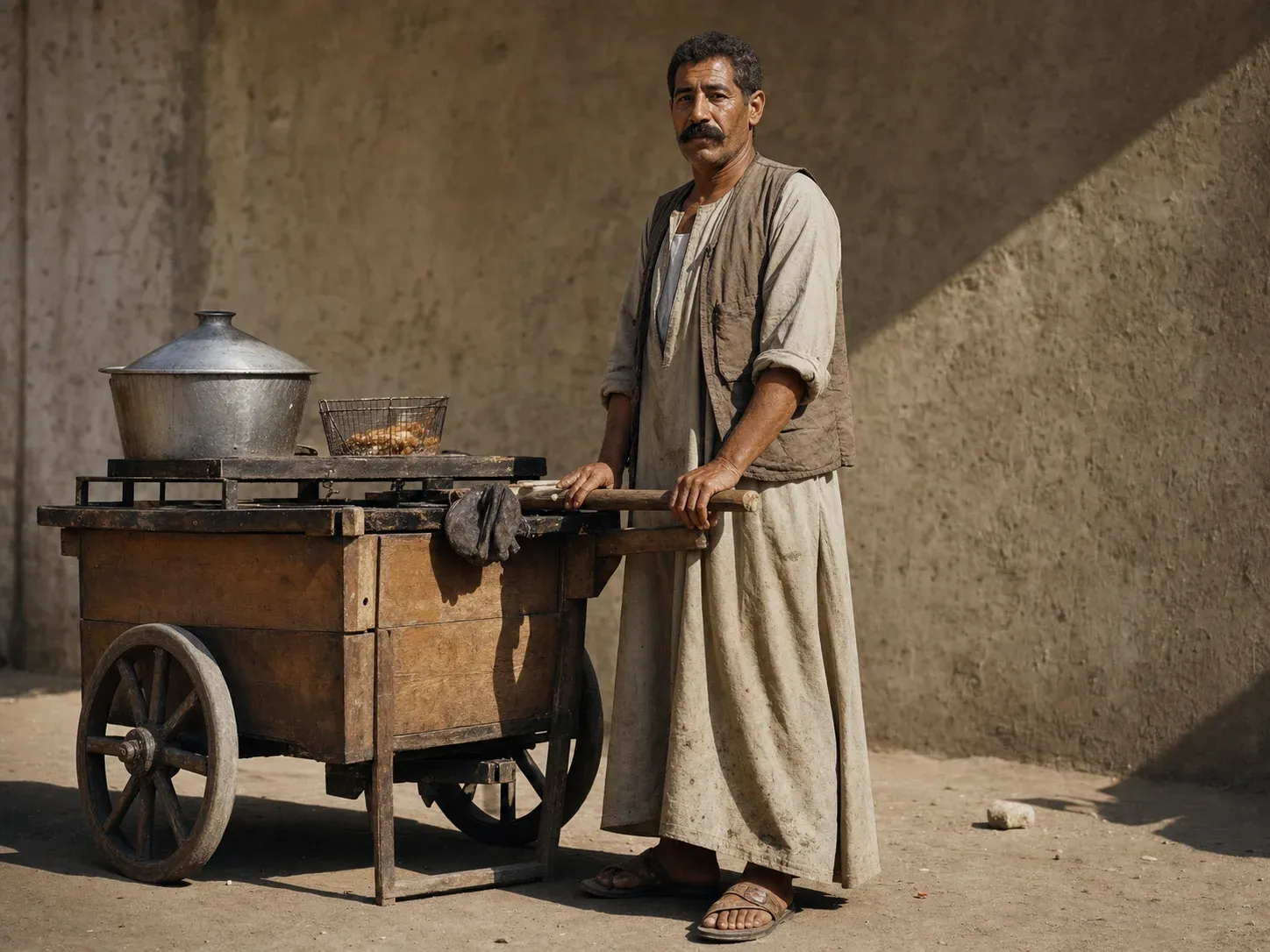
- Generate the vendor character sheet in GPT Image 2 (multi-angle turnaround). Regenerate until the face, moustache, and galabeya are exactly right. Save as
vendor_ref.png. / ولّد ورقة شخصية البائع في GPT Image 2 (دوران متعدد الزوايا). أعد التوليد حتى يثبت الوجه والشارب والجلابية. احفظها باسمvendor_ref.png.
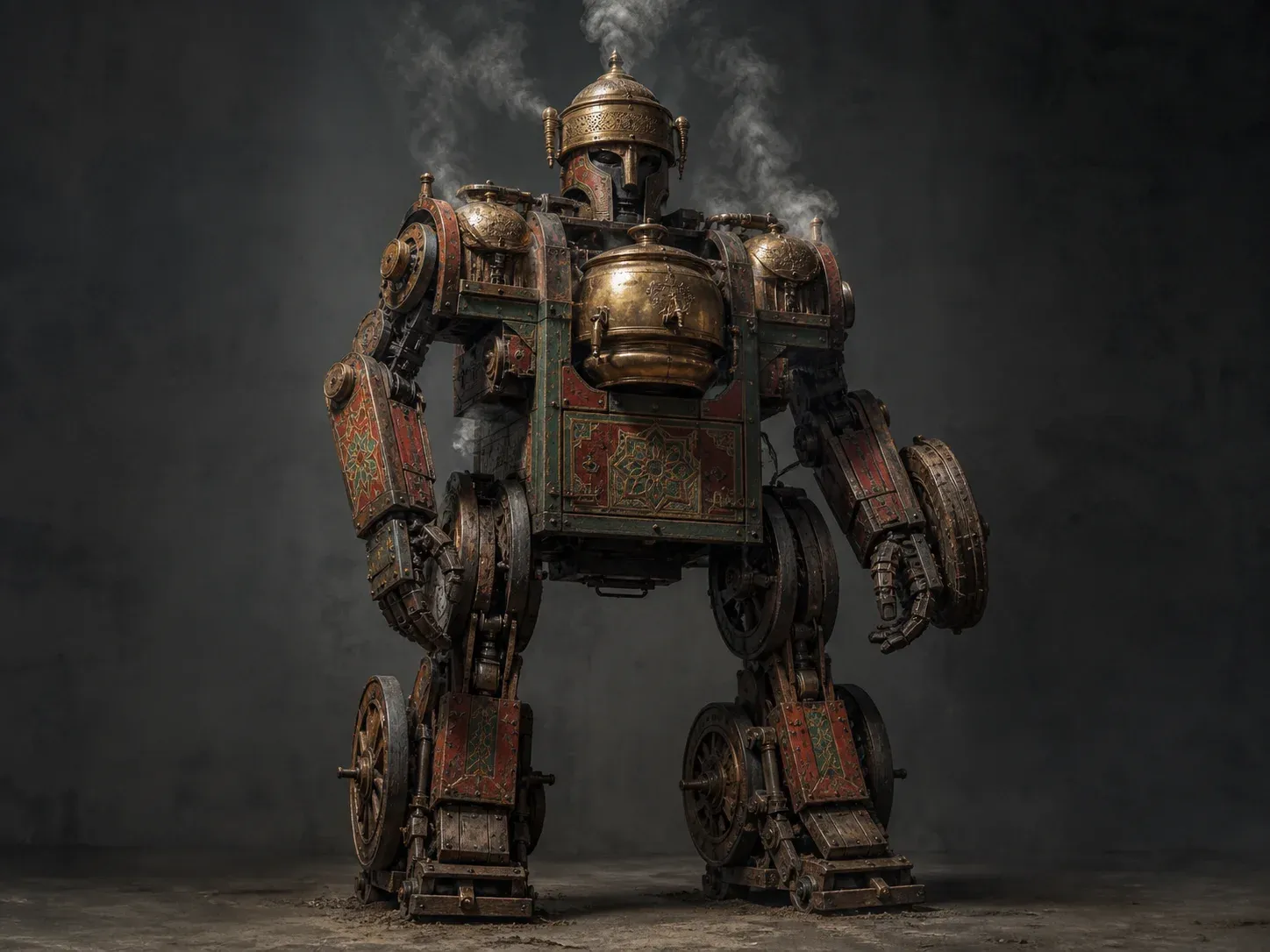
- Generate the transformer design sheet — the cart and its giant guardian form on one board so the model understands they are the same object in two states. Save as
transformer_ref.png. / ولّد ورقة تصميم المتحول — العربة وشكلها كحارس عملاق على لوحة واحدة ليفهم النموذج أنهما نفس الجسم في حالتين. احفظها باسمtransformer_ref.png.
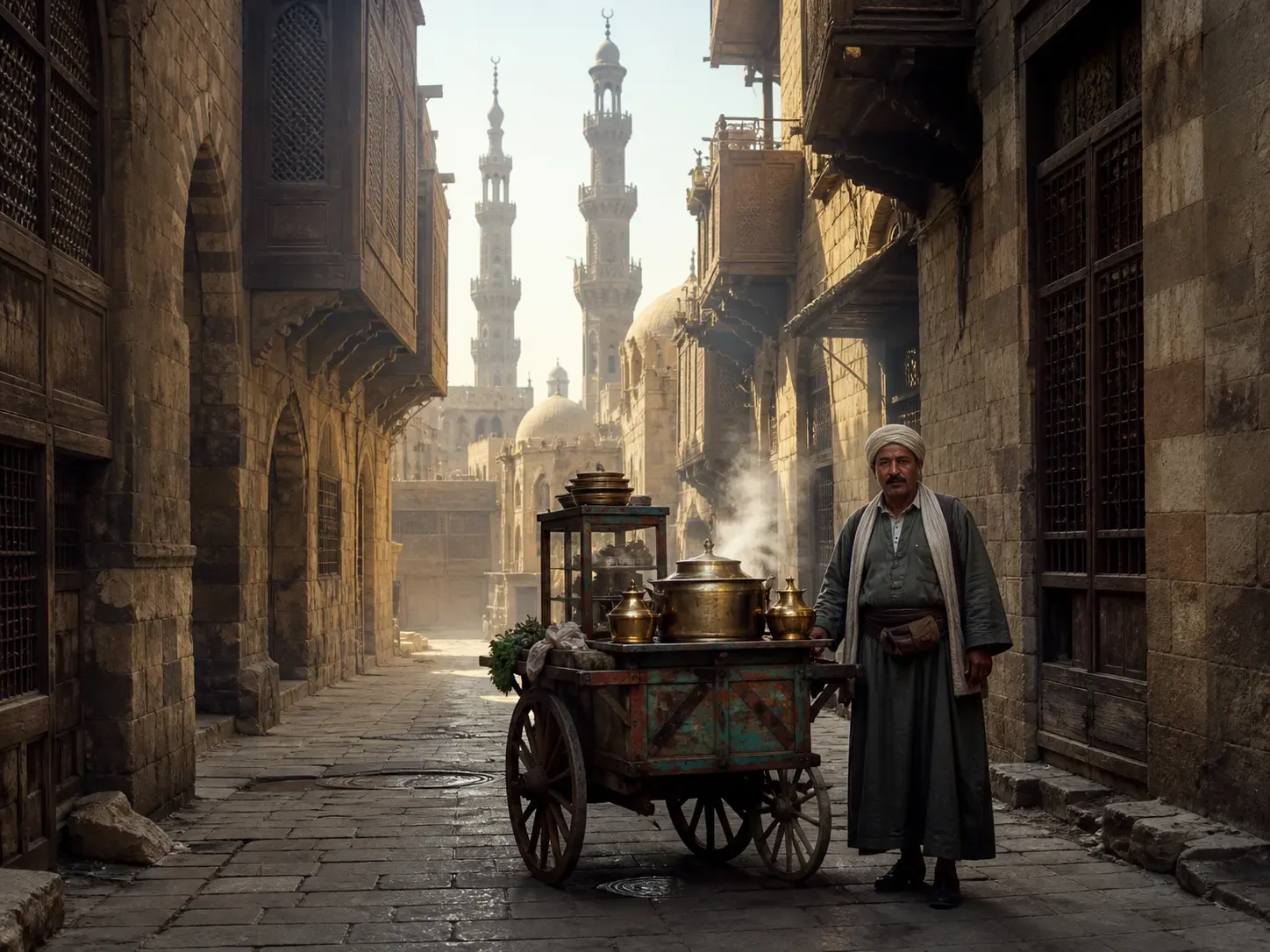
- Generate the environment sheet — the medieval Cairo alley as a clean establishing plate, no characters. Save as
alley_ref.png. / ولّد ورقة البيئة — زقاق القاهرة القديمة كلقطة تأسيسية نظيفة بلا شخصيات. احفظها باسمalley_ref.png.
- Assemble the Seedance 2.0 prompt and upload all three references with the matching
@names. / جمّع برومبت Seedance 2.0 وارفع المراجع الثلاثة بنفس أسماء@.
- Generate at 16:9 (or 9:16 for social), 8–10s. Review the transformation beat specifically — it is the hardest moment. / ولّد بنسبة 16:9 (أو 9:16 للسوشيال)، 8–10 ثوانٍ. راجع لحظة التحول تحديداً فهي الأصعب.
- Iterate on the single weakest beat rather than re-rolling the whole clip. / حسّن اللحظة الأضعف فقط بدلاً من إعادة توليد المقطع كله.
3. Character Sheet — The Egyptian Vendor / ورقة الشخصية — البائع المصري
EN — GPT Image 2 excels at structured, multi-region layouts and legible labels — so we build the character as a true reference sheet, not a single portrait. Paste the JSON below directly into GPT Image 2.
ع — يتفوق GPT Image 2 في التخطيطات المنظمة متعددة المناطق والعناوين الواضحة — لذلك نبني الشخصية كـورقة مرجعية حقيقية لا كبورتريه واحد. الصق الكود أدناه مباشرة في GPT Image 2.
Character Sheet - Prompt
{
  "type": "character reference sheet / model turnaround",
  "style": "35mm film photography aesthetic, grounded realism, natural Cairo sunlight, fine grain, editorial detail — NOT plastic CGI, NOT cartoon",
  "character": {
    "identity": "authentic working-class Egyptian male street-food vendor, approximately 40 years old",
    "face": "olive skin, weathered sun-worn skin shaped by years of labour, short dark hair, thick traditional Egyptian moustache, warm but serious expression, deep-set dark eyes",
    "build": "lean wiry working build",
    "wardrobe": "dusty beige cotton galabeya, worn sleeveless vest over it, sleeves rolled up, traditional Egyptian leather sandals, faint sweat and street dust on fabric"
  },
  "layout": {
    "top_row": {
      "count": 3,
      "labels": ["front view full body", "3/4 side view full body", "back view full body"],
      "note": "consistent identical face, wardrobe and proportions across all three"
    },
    "middle_row": {
      "count": 3,
      "labels": ["head close-up neutral", "head 3/4 expression: tired/serious", "hands gripping a wooden cart handle"]
    },
    "bottom_strip": {
      "title": "WARDROBE & PROP DETAILS",
      "count": 4,
      "labels": ["galabeya fabric texture", "sandals detail", "vest detail", "dust & sweat detail on sleeve"]
    }
  },
  "background": "neutral warm sandstone-grey studio sweep with subtle soft shadow, no environment props",
  "typography": "small clean sans-serif labels under each panel, light grey",
  "signature": "small 'AI Guide — Sameh Al Tawil' wordmark bottom-right corner"
}
4. Character Sheet — The Food-Cart Transformer / ورقة الشخصية — العربة المتحولة
EN — The key trick: show the cart and its giant guardian form on the same board with an arrow between them, so the model treats them as a single object in two states — the basis for a believable on-screen transformation. The design language is Egyptian engineering heritage (Fatimid/Mamluk geometry, brass, copper, weathered wood) — not futuristic sci-fi.
ع — الحيلة الأساسية: أظهر العربة وشكلها العملاق كحارس على اللوحة نفسها مع سهم بينهما، ليتعامل النموذج معهما كجسم واحد في حالتين — وهو أساس التحول المقنع على الشاشة. لغة التصميم هي تراث الهندسة المصرية (زخارف فاطمية ومملوكية، نحاس، خشب متعتق) — وليست خيالاً علمياً مستقبلياً.
{
  "type": "concept design reference sheet — single object, two states (vehicle ↔ mecha)",
  "style": "ultra-detailed industrial concept art, photoreal materials, grounded realism, large-format cinematic lighting, weathered patina — NOT chrome sci-fi, NOT cartoon",
  "layout": {
    "left_panel": {
      "title": "STATE A — FUUL CART / حالة أ — عربة الفول",
      "subject": "traditional Egyptian fava-beans street cart: hand-painted red and green wooden panels, Arabic calligraphy signage, weathered flaking paint, large wooden spoked wheels, brass and aluminium fuul cooking pots with rising steam, baskets of vegetables and eggs, glass bottles, decades of daily-use wear"
    },
    "center_arrow": "large mechanical transformation arrow with exploded mid-transition detail: wooden panels unfolding, calligraphy plates separating into moving mechanical segments, wheels detaching into articulated joints, steam bursting from hidden brass vents",
    "right_panel": {
      "title": "STATE B — MECHANICAL GUARDIAN / حالة ب — الحارس الآلي",
      "subject": "gigantic humanoid Egyptian mechanical guardian assembled FROM the same cart parts: torso built from the painted wooden cart body, Fatimid and Mamluk geometric ornamentation, Arabic calligraphy etched into brass and copper plating, the cooking pots integrated as functional chest and shoulder vessels still emitting steam, articulated limbs from former wheels and axles, heavy believable mechanical joints"
    },
    "bottom_strip": {
      "title": "COMPONENT CALLOUTS",
      "count": 5,
      "labels": ["brass pot → chest core", "wooden wheel → shoulder joint", "calligraphy panel → armour plate", "steam vent mechanism", "copper hand actuator"]
    }
  },
  "material_notes": "weathered wood, hammered brass, oxidised copper, aged iron rivets, real dust and soot — consistent across both states",
  "background": "neutral dark concept-art grey, soft top light",
  "signature": "small 'AI Guide — Sameh Al Tawil' wordmark bottom-right corner"
}
5. Environment Sheet — Medieval Islamic Cairo Alley / ورقة البيئة — زقاق القاهرة الإسلامية
EN — A clean establishing plate with no characters — pure environment so it can serve as a stable background reference and never fights the vendor's identity.
ع — لقطة تأسيسية نظيفة بلا شخصيات — بيئة خالصة تصلح كمرجع خلفية ثابت ولا تتعارض مع هوية البائع.
Environment Sheet - Prompt
{
“type”: “master_environmental_continuity_grid”,
“title”: “Medieval Islamic Cairo Alley — Environment & Transformation Continuity Grid”,
“workflow”: {
“platform”: “Seedance 2.0 OMNI”,
“secondary_workflow”: “Dreamina cinematic scene extension”,
“purpose”: “image-fed consistency workflow for cinematic AI filmmaking”,
“output_use”: [
“production design bible”,
“environmental continuity system”,
“historical architecture guide”,
“transformation continuity map”,
“material and texture library”,
“lighting bible”,
“atmosphere reference”,
“image-to-video consistency sheet”
]
},
“references”: {
“@alley_ref.png”: “environment identity reference: medieval Islamic Cairo alley, narrow historic stone street, Mamluk and Fatimid architectural influence, mashrabiya woodwork, dust, warm sunlight”,
“@transformer_ref.png”: “fuul cart and mechanical guardian transformation design reference: hand-painted Egyptian fuul cart transforming into a handcrafted brass, copper, wood and calligraphy mechanical guardian”,
“@vendor_ref.png”: “subject identity reference: 40-year-old Egyptian male fuul-cart vendor, olive skin, dark hair, thick moustache, tired serious expression, simple galabeya, worn vest, sandals, dusty fabric, sweaty hands gripping cart handle”
},
“final_prompt”: {
“core_instruction”: “Create an ultra-detailed cinematic environmental continuity board for a historical fantasy-realism film set inside a medieval Islamic Cairo alley, using the attached references as continuity anchors. The board must visually combine environment, vendor, fuul cart, transformation stages, guardian materials, lighting, props, color palette, and camera geography into one high-end filmmaker production design bible.”,
“primary_goal”: “Create absolute environmental and transformation continuity across multiple shots, multiple camera angles, closeups, wide shots, tracking shots, transformation sequences, room or alley extensions, and image-to-video AI workflows.”,
“continuity_rule”: “Every architectural element, material, prop, weathering pattern, cart detail, transformation mechanism, guardian component, character scale, atmosphere, and lighting condition must remain identical across future generations.”
},
“environment”: {
“setting”: “medieval Islamic Cairo alley”,
“historical_layers”: [
“Historic Islamic Cairo”,
“Fatimid Cairo influence”,
“Mamluk Cairo influence”,
“Old Cairo alleyways”,
“working pedestrian street”,
“ancient Egyptian urban density”
],
“spatial_characteristics”: [
“narrow pedestrian passage”,
“ancient stone architecture”,
“irregular alley width”,
“organic urban density”,
“human-scale environment”,
“shopfronts and residential facades”,
“wooden mashrabiya balconies”,
“arched entrances”,
“aged stone paving”,
“distant historic Cairo skyline visible between buildings”
],
“visual_mood”: [
“Egyptian folk legend”,
“historical realism”,
“living heritage”,
“warm sunlight”,
“ancient craftsmanship”,
“dust-filled air”,
“quiet dignity”,
“human labor”,
“mechanical wonder hidden inside tradition”
],
“emotional_quality”: “The environment must feel real, inhabited, historically grounded, cinematic, and emotionally powerful, never theme-park fantasy.”
},
“board_layout”: {
“aspect_ratio”: “16:9”,
“resolution”: “ultra high resolution, 8K preferred”,
“style”: [
“high-end production design presentation”,
“editorial continuity board”,
“clean museum-quality documentation”,
“asymmetrical cinematic layout”,
“dense but readable information design”
],
“background”: “soft white or archival off-white”,
“rules”: [
“no overlapping elements”,
“no cropped references”,
“no watermark”,
“no logo”,
“no decorative clutter”,
“all sections clearly labeled”,
“all objects fully visible”,
“consistent scale logic”
]
},
“mandatory_sections”: {
“A_master_alley_hero_frame”: {
“description”: “Large cinematic hero image of the exact alley where the story occurs.”,
“must_show”: [
“complete alley geography”,
“building relationships”,
“street width”,
“door placement”,
“shopfronts”,
“wooden mashrabiyas”,
“stone paving”,
“historic facades”,
“sunlight direction”,
“dust atmosphere”,
“architectural rhythm”,
“human scale”,
“vendor with fuul cart in the alley”,
“steam rising from brass pots”
]
},
“B_architectural_continuity_map”: {
“description”: “Top-down environmental plan for blocking and camera movement.”,
“must_include”: [
“main alley”,
“secondary passages”,
“building entrances”,
“courtyards”,
“archways”,
“shop doors”,
“windows”,
“roof access”,
“historical street furniture”,
“camera routes”,
“vendor route”,
“guardian standing position”,
“transformation location”,
“sun path”,
“shadow direction”,
“dust and steam direction”
]
},
“C_material_texture_library”: {
“description”: “Macro material studies for environment, cart, and guardian.”,
“macro_studies”: [
“aged limestone”,
“sandstone”,
“mud plaster”,
“limewash”,
“wooden doors”,
“mashrabiya wood”,
“copper”,
“brass”,
“iron hinges”,
“stone paving”,
“rope fibers”,
“painted Arabic calligraphy”,
“ceramic surfaces”,
“weathered pigments”,
“cart wood”,
“wheel wood”,
“oxidized metals”,
“steam-stained metal”,
“dust-covered surfaces”
],
“must_show”: [
“micro-detail”,
“surface wear”,
“dust accumulation”,
“repair marks”,
“centuries of aging”,
“historical authenticity”
]
},
“D_age_weathering_system”: {
“description”: “Dedicated degradation references for all surfaces.”,
“must_include”: [
“stone erosion”,
“sand abrasion”,
“water staining”,
“lime deposits”,
“cracked plaster”,
“sun fading”,
“metal oxidation”,
“polished wear from touch”,
“wood splitting”,
“paint deterioration”,
“dust layers”,
“bird staining”,
“repair patches”,
“historical repairs”,
“heat discoloration”,
“steam residue”
],
“rule”: “Every surface must feel aged, used, repaired, and historically believable.”
},
“E_lighting_bible”: {
“description”: “Lighting studies for consistent cinematic atmosphere.”,
“scenarios”: [
“morning sun”,
“midday sun”,
“late afternoon”,
“golden hour”,
“dusty backlight”,
“steam interaction”,
“shadow interaction”,
“volumetric alley light”
],
“must_show”: [
“surface response”,
“shadow behavior”,
“dust visibility”,
“steam visibility”,
“metal reflections”,
“stone reflections”,
“human skin response”,
“wood response”,
“brass response”,
“guardian response”
]
},
“F_camera_geography”: {
“description”: “Storyboard-style camera reference frames with placement diagrams.”,
“angles”: [
“extreme wide”,
“wide”,
“medium”,
“close-up”,
“low angle”,
“high angle”,
“overhead”,
“tracking shot”,
“vendor POV”,
“guardian POV”,
“transformation view”,
“alley compression”,
“doorway framing”,
“architectural framing”,
“detail insert”
]
},
“G_fuul_cart_continuity_grid”: {
“description”: “Orthographic production references for the Egyptian fuul cart.”,
“views”: [
“front”,
“back”,
“left”,
“right”,
“top”,
“3/4 view”,
“exploded mechanical breakdown”
],
“must_include”: [
“hand-painted wooden panels”,
“Arabic signage”,
“brass cooking pots”,
“aluminium pots”,
“steam vents”,
“wooden wheels”,
“wheel construction”,
“storage compartments”,
“vegetable baskets”,
“eggs”,
“glass bottles”,
“surface aging”,
“paint weathering”,
“repair marks”,
“heavy grounded structure”
],
“continuity_rule”: “The cart must remain identical across all shots before transformation.”
},
“H_transformation_continuity_system”: {
“description”: “Mechanical transformation stages from fuul cart to Egyptian guardian.”,
“stages”: [
“Stage 01: normal fuul cart”,
“Stage 02: panel separation”,
“Stage 03: wheel articulation”,
“Stage 04: brass pot repositioning”,
“Stage 05: torso formation”,
“Stage 06: leg construction”,
“Stage 07: arm construction”,
“Stage 08: guardian completion”
],
“must_include”: [
“engineering diagrams”,
“exploded components”,
“gear systems”,
“chains”,
“hinges”,
“steam vents”,
“brass pistons”,
“wooden latches”,
“Arabic calligraphy plates becoming armor”,
“wheels becoming shoulder or joint mechanisms”
],
“transformation_rules”: [
“heavy”,
“mechanical”,
“physically believable”,
“Egyptian handcrafted engineering”,
“rooted in heritage”,
“not futuristic”,
“not alien”,
“not chrome sci-fi”
]
},
“I_guardian_material_library”: {
“description”: “Macro studies of the mechanical guardian materials.”,
“macro_studies”: [
“weathered wood”,
“aged brass”,
“oxidized copper”,
“wrought iron”,
“rivets”,
“hinges”,
“steam vents”,
“calligraphy plates”,
“Fatimid ornamentation”,
“Mamluk geometry”,
“mechanical joints”,
“heat discoloration”,
“dust and soot”,
“steam residue”
],
“must_show”: [
“patina”,
“wear”,
“repair marks”,
“handmade imperfection”,
“mechanical weight”,
“historic craft logic”
]
},
“J_prop_continuity_grid”: {
“description”: “Street prop library for alley authenticity.”,
“props”: [
“brass lanterns”,
“water jars”,
“wooden stools”,
“market baskets”,
“hanging fabrics”,
“door knockers”,
“pigeon nests”,
“street signs”,
“stone benches”,
“historic locks”,
“rope bundles”,
“merchant tools”,
“small clay pots”,
“old wooden crates”
]
},
“K_color_script”: {
“description”: “Environmental and transformation color palette.”,
“palette”: [
“desert sand”,
“limestone beige”,
“warm dust”,
“burnt umber”,
“aged copper”,
“oxidized brass”,
“terracotta”,
“sunlit gold”,
“weathered wood”,
“deep shadow brown”,
“historic green patina”,
“steam white”,
“faded red cart paint”,
“aged Arabic calligraphy gold”
],
“palette_rule”: “Earthy, sun-washed, timeless, historical; no fantasy colors and no modern color grading.”
},
“L_atmospheric_continuity”: {
“description”: “Environmental mood and air behavior studies.”,
“must_show”: [
“floating dust”,
“steam clouds”,
“pigeon movement”,
“sun shafts”,
“heat haze”,
“wind behavior”,
“street depth”,
“air density”,
“volumetric lighting”,
“alley ambience”,
“texture softening through dust”
],
“rule”: “The atmosphere must feel alive, humid, dusty, warm, and physically present.”
}
},
“vendor_continuity”: {
“identity”: “40-year-old Egyptian male fuul-cart vendor based on @vendor_ref.png”,
“appearance”: [
“olive skin”,
“dark short hair”,
“thick black moustache”,
“tired serious face”,
“weathered skin”,
“sweat and dust”,
“simple working-class presence”
],
“wardrobe”: [
“simple beige galabeya”,
“worn brown or grey vest”,
“rolled sleeves”,
“dusty fabric”,
“worn leather sandals”
],
“body_language”: [
“heavy pulling posture”,
“hands gripping wooden cart handle”,
“slow exhausted movement”,
“wipes sweat from forehead”,
“looks toward Cairo skyline”,
“stands beside the guardian with quiet dignity”
]
},
“cinematography”: {
“camera_emulation”: “ARRI Alexa 35”,
“format”: “large-format cinematic realism”,
“lens_character”: [
“Cooke lens softness”,
“vintage optical softness”,
“subtle diffusion”,
“organic contrast rolloff”
],
“film_emulation”: “Kodak Vision3”,
“lighting”: [
“natural sunlight”,
“warm atmospheric sun”,
“volumetric dust”,
“steam backlight”,
“realistic exposure falloff”
],
“image_quality”: [
“ultra-photorealistic”,
“micro-detail preservation”,
“historical epic cinematography”,
“practical realism”,
“subtle depth of field”,
“organic camera logic”
]
},
“ai_optimization”: {
“optimized_for”: [
“Seedance 2.0 OMNI”,
“Dreamina”,
“image-to-video workflows”,
“environment continuity”,
“transformation continuity”,
“architecture continuity”,
“historical consistency”,
“reference-feed workflows”,
“multi-shot cinematic generation”
],
“generation_rules”: [
“all objects must be clearly visible”,
“all materials must be highly readable”,
“maintain one consistent alley identity”,
“maintain one consistent cart identity”,
“maintain one consistent guardian design”,
“maintain one consistent vendor identity”,
“no changing geometry between panels”,
“no inconsistent proportions”,
“no floating components”,
“transformation parts must logically come from the cart”
]
},
“negative_prompt”: [
“modern architecture”,
“tourist locations”,
“restored museum appearance”,
“clean stone”,
“modern Cairo”,
“cars”,
“motorcycles”,
“electric lights”,
“LEDs”,
“glass skyscrapers”,
“fantasy architecture”,
“sci-fi materials”,
“chrome robots”,
“anime”,
“cartoon styling”,
“steampunk”,
“cyberpunk”,
“floating objects”,
“modern signage”,
“plastic materials”,
“unrealistic proportions”,
“sterile surfaces”,
“luxury aesthetics”,
“overly polished materials”,
“theme park look”,
“AI-glossy CGI look”
],
“quality_tags”: [
“historical production design”,
“medieval Cairo continuity board”,
“Islamic architecture reference”,
“environmental storytelling”,
“film production bible”,
“Fatimid architecture”,
“Mamluk architecture”,
“Egyptian heritage”,
“Egyptian fuul cart”,
“mechanical guardian design”,
“transformation continuity”,
“architectural continuity”,
“material continuity”,
“Seedance 2.0 OMNI optimized”,
“Dreamina workflow ready”,
“cinematic historical realism”,
“award-winning production design”
],
“output_specification”: {
“format”: “single image board”,
“aspect_ratio”: “16:9”,
“style”: “ultra-detailed cinematic production design continuity grid”,
“readability”: “high-density but clean and organized”,
“background”: “soft off-white”,
“final_feeling”: “An Egyptian folk legend brought to life through ultra-realistic cinema and production-design precision.”
}
}
6. Final Seedance 2.0 Prompt / البرومبت النهائي لـ Seedance 2.0
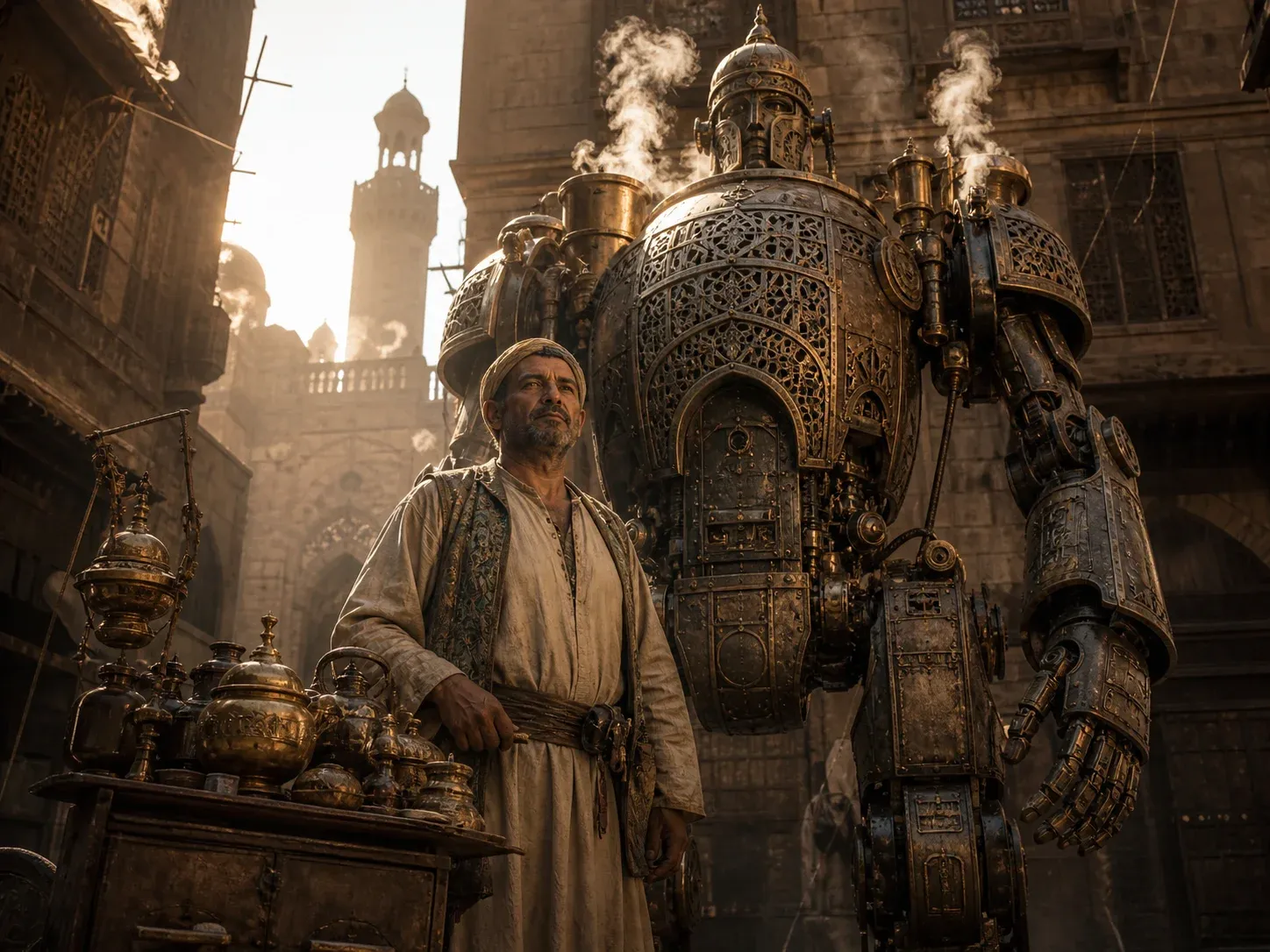
EN — Upload the three sheets named exactly vendor_ref.png, transformer_ref.png, alley_ref.png. Seedance reads each @ reference by filename and assigns it a role: identity, object/design, and environment. One continuous shot, no cuts.
ع — ارفع الأوراق الثلاث بأسماء مطابقة تماماً: vendor_ref.png وtransformer_ref.png وalley_ref.png. يقرأ Seedance كل مرجع @ باسم الملف ويسند له دوراً: الهوية، الجسم/التصميم، البيئة. لقطة واحدة مستمرة بلا قطع.
{
  "final_prompt": "Single continuous cinematic shot, no cuts, no transitions. Set the entire scene in the medieval Islamic Cairo alley from @alley_ref.png as the environment. Open on a medium-wide static shot at a 30-degree side angle, then slowly push the camera forward. A 40-year-old Egyptian fuul-cart vendor — use @vendor_ref.png as the subject identity reference — slowly pulls his heavy hand-painted wooden fava-beans cart toward camera; the wooden wheels creak on the ancient stone, steam rises continuously from the brass cooking pots, the cart feels heavy and grounded. He pauses in the centre of the alley, wipes sweat from his forehead, looks toward the historic Cairo skyline between the buildings, and takes a deep breath. At that moment the cart transforms: use the design in @transformer_ref.png as the transformation reference — wooden panels unfold, painted Arabic calligraphy plates separate into moving mechanical segments, brass pots rotate and reposition, wheels detach into articulated joints, steam bursts from hidden vents, and the cart rises and reassembles into a gigantic humanoid Egyptian mechanical guardian built from its own parts, in Fatimid and Mamluk geometric ornamentation with weathered wood, brass and copper. The transformation is powerful, heavy and mechanically believable — handcrafted Egyptian engineering heritage, not futuristic sci-fi. The giant guardian lands beside the vendor; the two stand side by side in the centre of the alley as steam rises and dust drifts through sunlight. The camera keeps pushing closer until both figures dominate the frame. Ultra-photorealistic large-format cinematic realism, natural sunlight mixed with atmospheric steam, volumetric lighting, extreme micro-detail, subtle depth of field, organic camera movement, award-winning historical-epic cinematography. No fantasy colours, no cartoon styling. Audio: no music, no dialogue — only wooden wheel creaks, metal pot rattles, steam hissing, distant Cairo street ambience, fluttering pigeons, footsteps on stone, wind through alleyways, and mechanical transformation sounds of wood, brass, gears, chains and heavy metal. The final atmosphere feels like an Egyptian folk legend brought to life through ultra-realistic cinema.",
  "references": {
    "@vendor_ref.png": "subject / character identity",
    "@transformer_ref.png": "object & transformation design",
    "@alley_ref.png": "environment / background"
  },
  "recommended_parameters": {
    "duration": 10,
    "aspect_ratio": "16:9",
    "note": "use 9:16 for social cuts; keep it a single continuous take"
  }
}
Optional Prompt for the transformation scene only:
{
	"final_prompt": "15-second cinematic transformation sequence, the ONLY subject is the transformation itself. Medieval Islamic Cairo alley from @image_3.png as the environment, warm volumetric god-rays and drifting steam. The 40-year-old Egyptian vendor (use @image_1.png as subject identity) and the cart transforming into the guardian (use @image_2.png as the transformation design reference). Shot like an epic robot-reveal sequence — multiple cinematic hard cuts between dramatic rare angles, NOT one continuous push-in. SHOT 1 (0–2s): Extreme close-up, low macro angle, on the vendor's weathered hand as fingertips touch the worn wooden edge of the cart. A beat of stillness. Then a single brass bolt clicks and rotates under his fingers — the first sign of life. SHOT 2 (2–4s): HARD CUT to a low hero angle looking up the side of the cart as the painted red-and-green wooden panels crack open and unfold outward in sequence, Arabic calligraphy plates separating like turning pages, dust and paint flakes raining down through the light. SHOT 3 (4–6s): CUT to an extreme close-up macro detail — brass and copper gears interlocking, chains pulling taut, articulated joints snapping into place, steam screaming from hidden vents in sharp jets, every rivet and weathered-metal surface in crisp micro-detail. SHOT 4 (6–8s): CUT to a sweeping low orbit around the structure as the wooden wheels detach and rotate into massive articulated leg joints, the cart's frame rising and stacking vertically, the cooking pots locking into the chest as a glowing-warm functional core. SHOT 5 (8–10.5s): CUT to a dramatic dutch-angle from below as the torso assembles — Fatimid and Mamluk geometric plating folding into armour, copper arms swinging into position with heavy believable momentum, the head unit rising last with a deep mechanical lock. SHOT 6 (10.5–12.5s): CUT to a wide low silhouette as the colossus completes and plants its feet, a ground-shaking settle that throws a ring of dust outward through the sunlit alley. SHOT 7 (12.5–15s): CUT to the CLOSING HERO SHOT — slow cinematic push-in on a heroic low angle: the small weathered vendor standing firm in the foreground, the towering mechanical guardian fully revealed behind and beside him, steam rising, dust drifting through hard backlight, the two framed together as legend and maker. Ultra-photorealistic large-format cinematic realism, dramatic high-contrast lighting, deep shadows, extreme micro-detail on weathered wood, hammered brass and oxidised copper, shallow depth of field, motion-blur on moving parts, award-winning Transformers-style mechanical choreography grounded in Egyptian engineering heritage — NOT futuristic chrome sci-fi, NOT cartoon. Audio: no music, no dialogue — the soft tap of fingers on wood, a single bolt click, then escalating mechanical foley: wood cracking and unfolding, brass gears grinding, chains snapping taut, steam hissing and screaming, heavy metal joints locking, building to the thunderous ground-shaking impact of the guardian planting its feet, settling into a low mechanical hum and drifting alley ambience.",
	"references": {
		"@image_1.png": "subject / character identity",
		"@image_2.png": "object & transformation design reference",
		"@image_3.png": "environment / background"
	},
	"recommended_parameters": {
		"duration": 15,
		"aspect_ratio": "16:9",
		"note": "seven cinematic cuts within 15s; this is a montage of the transformation, edits are intentional. Use 9:16 for vertical hero cut by reframing shots 1, 3, 5 and 7."
	}
}
7. Director's Notes / ملاحظات إخراجية
EN
- Lock identity first. Never start the video before the vendor sheet is perfect — Seedance can only stay consistent with a clean reference.
- The transformation is the hardest beat. If it looks like sci-fi chrome, regenerate the transformer sheet with stronger "weathered wood / brass / Mamluk geometry" weighting before touching the video.
- One object, two states. The same-board design in §4 is what makes the morph read as believable rather than a swap.
- Sound sells it. The wood-and-brass mechanical foley, with no music, is what pushes this from VFX demo to folk legend.
AR
- ثبّت الهوية أولاً. لا تبدأ الفيديو قبل أن تكتمل ورقة البائع — لا يثبت Seedance إلا بمرجع نظيف.
- التحول هو اللحظة الأصعب. إن بدا كروم خيال علمي، أعد توليد ورقة المتحول بتركيز أقوى على "الخشب المتعتق / النحاس / الهندسة المملوكية" قبل لمس الفيديو.
- جسم واحد، حالتان. تصميم اللوحة الواحدة في القسم 4 هو ما يجعل التحول مقنعاً لا مجرد استبدال.
- الصوت هو ما يبيع اللقطة. مؤثرات الخشب والنحاس الميكانيكية بلا موسيقى هي ما يرفعها من عرض مؤثرات إلى أسطورة شعبية.
AI Guide — Sameh Al Tawil · دليل الذكاء الاصطناعي — سامح الطويل