
Co-Authored Aesthetics: How Generative AI Is Revolutionizing Art, Music, and Media
١٩/٨/٢٠٢٦
By: Sameh Al Tawil
Land of Persia - Human x machine improvisation, orchestrated by Sameh Al Tawil on piano, with musical arrangement in collaboration with GenAi agents.
From Tool to Co-Author
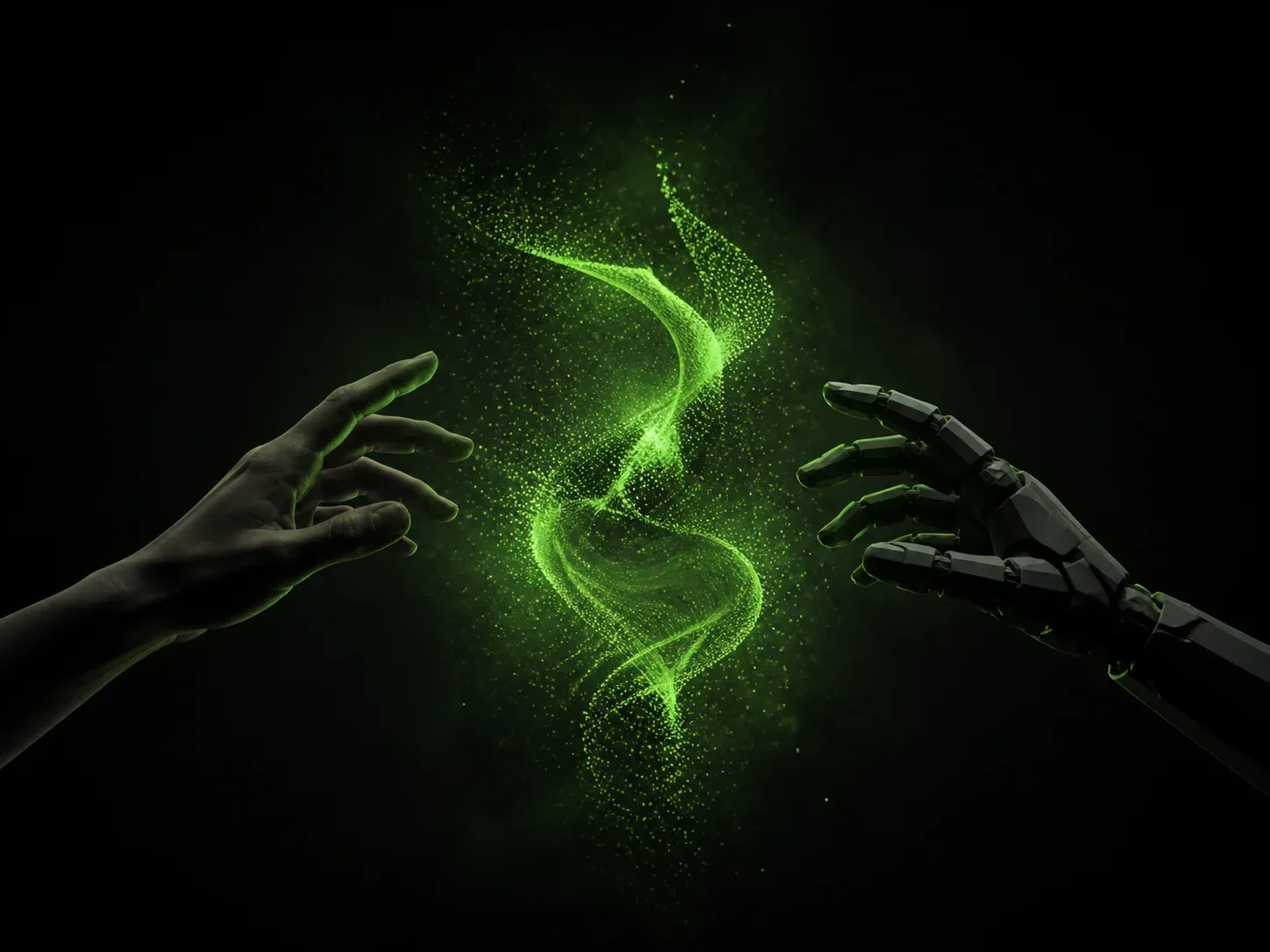
The recent explosion of generative artificial intelligence into the cultural mainstream has been met with a familiar mix of utopian enthusiasm and dystopian anxiety. For some, these technologies herald a new era of democratized creativity, where anyone can become an artist, musician, or filmmaker. For others, they signal the end of human originality and the deskilling of creative labor. This article proposes a third path, one that moves beyond the simplistic binary of tool versus replacement. I argue that generative AI is most productively understood as a co-authoring apparatus, a partner in a complex and emergent creative process that challenges our most fundamental assumptions about art, authorship, and aesthetics.
This is not new, but rather a new chapter in the long dialogue between art and technology. Artists have always appropriated new technologies as active agents that reshape art's possibilities. What is different about generative AI is the nature of its agency. Unlike a paintbrush or piano, a generative model is an active participant in the creative process, a machinic partner that brings its own history, biases, and aesthetic tendencies. This partnership gives rise to machinic aesthetics: the unique visual, sonic, and textual languages emerging from human-nonhuman collaboration.
The stakes of this inquiry are high. As generative AI becomes increasingly integrated into creative workflows across music, visual arts, film, and literature, we face urgent questions about authorship, labor, authenticity, and cultural memory. How do we understand creativity when it is distributed across human intention and algorithmic process? What does it mean to preserve and archive works that are fundamentally process-based and dependent on specific computational systems? How do we ensure that the labor of the countless artists whose work was used to train these models is acknowledged and compensated? And perhaps most importantly, how do we maintain a commitment to justice, diversity, and ethical responsibility in a landscape increasingly shaped by corporate AI systems?
A Short Genealogy: From the Readymade to the Model
Generative art has a rich history in automata and mechanical art. However, I begin with Marcel Duchamp's readymade. With Fountain (1917) and Bicycle Wheel (1913), Duchamp radically redefined the artistic act. The artist became a selector, a re-contextualizer, a framer of meaning. The creative gesture was not in making the object, but in choosing it, declaring it art. This shift from fabrication to selection laid groundwork for conceptual art and prompt-based art today.
Image Caption: Marcel Duchamp Fountain, 1917
Conceptual artists like Sol LeWitt developed this further, stating that "the idea becomes a machine that makes the art." LeWitt's wall drawings were executed by assistants following written instructions. The artwork was the concept, the protocol, not the physical object. This separation of idea from execution is crucial to generative AI, where the artist becomes a designer of systems and creator of worlds. The prompt, in this genealogy, is the direct descendant of LeWitt's written instructions—a set of specifications that governs the machine's creative output.
This logic finds expression in software culture, Manovich's term for software's cultural and aesthetic impact. Software is our interface to the world, the engine of our economy, and the medium of our culture. Generative AI is the latest manifestation of this software culture, a form of cultural software trained on vast archives of human culture and used to generate new cultural forms in response to prompts. The model itself is a kind of cultural archive, a compressed representation of patterns extracted from millions of artworks, songs, and texts. As Pamela McCorduck's foundational work on AI and art demonstrates, the history of computational creativity stretches back decades, to early systems like Harold Cohen's AARON, which generated abstract drawings based on programmed rules and aesthetic principles.
Aaron's "Turtle" - Robot creating drawing in gallery 1979
Theoretical Frame: Archive, Assemblage, and the Subject
To grasp this paradigm's implications, we need a theoretical framework accounting for technology, culture, and subjectivity. I find this in post-structuralist thought: Jacques Derrida, Deleuze and Guattari, and Lacan, as well as new media theorists building on their insights.
The generative model's vast dataset functions as a new cultural archive. Drawing on Derrida's concept of the archive as a site of preservation and power, the dataset is a political entity shaped by creators' biases. Model outputs are inscribed with the trace of archived data. This is différance at work: the endless play of presence and absence characterizing all meaning systems. The archive is never neutral or complete; it is always already shaped by what has been included and, more importantly, what has been excluded or marginalized.
Micro-theoretical Passage:
The generative archive is not a passive repository of cultural memory, but an active, generative force. It is a hauntological machine that endlessly remixes the past, producing a future that is always already a ghost of what has been. To create with AI is to dance with these ghosts, to negotiate with the traces of a history that is both present and absent, visible and invisible.
The creative process itself can be understood as a rhizomatic assemblage, in the Deleuzo-Guattarian sense of the term. The human artist, the generative model, the dataset, the prompt—these are not discrete, hierarchical entities, but nodes in a non-linear, ever-shifting network. In this assemblage, traditional artistic roles are deterritorialized, and new, hybrid forms of creativity emerge. The AI is not a tool to be mastered, but a machinic partner in a process of mutual becoming. This partnership gives rise to a machinic aesthetics, an aesthetic that is not based on human intention or expression, but on the emergent properties of the human-machine system. Wendy Hui Kyong Chun's work on software and memory is particularly illuminating here, as she argues that software is never transparent or neutral, but is always already laden with history, ideology, and power. To work with generative AI is thus to work with these embedded histories, to negotiate with the traces of the past that are encoded in the model's parameters.
This paradigm challenges our understanding of the subject. The humanist ideal of the singular author, deconstructed by Barthes and Foucault, is further challenged by generative AI. The creative subject is no longer unified consciousness but a distributed, networked, post-human entity entangled with technology. As Hayles argues, we are already post-human, our lives intertwined with computational media. Generative AI makes this reality visible and unavoidable.
Generative AI and the New Grammar of Images
One of the most profound impacts of generative AI is on the very grammar of media, particularly the grammar of the moving image. As Lev Manovich has argued, new media is characterized by a database logic, in which the narrative is no longer the dominant cultural form, but is replaced by the database, a collection of discrete elements that can be endlessly combined and reconfigured. Generative AI is the ultimate expression of this database logic. It allows us to create images and videos not by capturing reality, but by sampling from a vast database of existing images and styles. This represents a fundamental shift in how we understand the image itself—no longer as a window onto reality, but as a constructed assemblage of computational processes.
This has led to the emergence of a new generative media grammar, one that is characterized by a logic of montage, simulation, and remediation. In my own music video work, such as Land of Persia and Spinphony, I have explored this new grammar, using AI to create surreal, dreamlike landscapes and to animate historical photographs and paintings. The machine becomes not just a tool for creating special effects, but a performer in its own right, an editor with its own unique sense of rhythm and flow. Peter Weibel's concept of media art as a critical apparatus is particularly relevant here. Rather than using AI simply to produce beautiful or technically impressive images, we can deploy it as a tool for institutional and cultural critique, exposing the hidden assumptions and power structures embedded in visual representation itself.
This new grammar also raises new challenges for preservation and archiving. As Oliver Grau has argued, media art is often ephemeral, interactive, and process-based, making it difficult to preserve using traditional archival methods. This is especially true of generative art, which is often created in real-time and is dependent on specific software and hardware. The work of media archaeologists like Erkki Huhtamo and Siegfried Zielinski has shown us that we must develop new strategies for understanding and preserving digital media, ones that account for the historical contingency and material specificity of computational systems. To preserve this work, we need new models of archiving, ones that are themselves dynamic, interactive, and generative. We need to move from a logic of preservation to a logic of re-performance, from the static archive to the living archive, where the artwork is understood not as a fixed object but as a process that must be continually re-enacted and re-interpreted. This means preserving not just the final artwork, but the prompts, the datasets, the parameters, the entire generative ecosystem that brought the work into being.
Spinphony سيمفونية الدوران - a snapshot of the GenAi Music video by Sameh Al Tawil in collaboration with Ai models and agents.
Generative AI in Music: Improvisation With a Nonhuman Partner
The co-authoring paradigm of generative AI is perhaps most palpable in the realm of music. My recent album, Automaton, is a series of improvisational duets between myself and a generative music AI. The process is one of call and response, a feedback loop of constraint-based improvisation. I might begin with a simple melodic phrase or a rhythmic pattern, and the AI will respond with a series of variations, which I can then edit, rearrange, and feed back into the system. The result is a kind of "third mind," a term William S. Burroughs and Brion Gysin used to describe their collaborative writing process, a creative entity that is neither fully human nor fully machine, but something in between.
Music presents a unique case for understanding human-machine co-authorship. Unlike visual media, which can be analyzed through database logic and montage, music unfolds in time. It involves patterns operating at multiple scales simultaneously: the micro-level of individual notes and timbral qualities, the meso-level of melodic phrases and harmonic progressions, and the macro-level of overall structure and form. Music also carries emotional and intentional dimensions that are difficult to quantify or encode algorithmically. This is why music has historically been one of the most resistant domains for AI generation, and why the achievements of contemporary AI music systems are all the more remarkable and troubling.
Vignette from an Automaton jam session: The session begins in silence. I play a sparse, melancholic piano melody into the system—just a few notes hanging in the air. The AI listens, processes, and responds. It doesn't just mimic the melody; it deconstructs it, inverts it, harmonizes it with a ghostly choir of synthesized voices. It introduces a rhythmic element, a syncopated beat that pulls the track in a new direction. I am no longer the sole composer; I am a listener, a curator, a collaborator. I take the AI's offering, loop it, filter it, add a bassline, and send it back. The machine responds again, this time with a flurry of arpeggiated strings that cascade around the melody. We are jamming, not as master and slave, but as partners in a shared exploration of sonic space.
Recent scholarship on AI in music has raised important questions about the nature of musical creativity and the specific challenges that music poses for artificial intelligence. Christopher White's The AI Music Problem argues that music presents unique and complex challenges for AI, even as 21st-century AI grows more adept at generating compelling content in other domains. White contends that the difficulties music poses for AI connect to larger questions about music, artistic expression, and the increasing ubiquity of artificial intelligence. White's analysis is crucial because it resists the techno-optimism that often surrounds AI applications, instead offering a nuanced understanding of what AI can and cannot do in the musical domain.
Mark SEBBY's Harmonizing Innovation: Navigating AI's Role in the Music Industry situates AI music within the broader context of the music industry, examining how AI is transforming marketing, distribution, and audience engagement. SEBBY notes that AI-driven strategies allow for more personalized audience engagement through data analysis that identifies listener habits and preferences. Yet SEBBY also warns of the dangers of algorithm-driven marketing that can lead to oversaturation and the erosion of authentic relationships between artists and fans. This industry-level analysis reveals that the implications of AI in music extend far beyond the creative process itself, affecting how music is marketed, consumed, and valued in contemporary society.
Malfunction | عيب تصنيع - A Human x Machine Rap Music Video by Sameh Al Tawil 2025, Part of Short Shadows art project.
Practice-Based Evidence: Homeland and Short Shadows
My multidisciplinary project Homeland explores themes of memory, belonging, and mediated identity through a sci-fi narrative and a machinima-based media ecosystem. The project uses generative AI to create a "paraverse," a speculative reality where cultural artifacts, like the bust of Nefertiti, are liberated from their museum prisons and set free in a world of generative media. Here, AI is not just a tool for creating visuals, but a narrative device, a way of exploring alternate histories and futures. The project asks: what does it mean to have a homeland when your identity is mediated by algorithms and your memories are stored in the cloud? This question becomes increasingly urgent in an age where cultural heritage is increasingly digitized, archived, and subject to algorithmic curation.
My project Short Shadows takes this exploration of co-authorship even further. It is a human-machine micro-fiction and generative visuals, videos and music ecosystem built around a series of bilingual "prompt-fictions." Each text is designed to function as both a piece of literature for a human reader and an executable prompt for a generative AI. The prompt, in this context, becomes a form of protocol, a set of instructions that governs the machine's creative output. This reframes the act of writing itself as a form of prompt engineering, a poetic procedure for communicating with a non-human intelligence.
This notion of the prompt as protocol connects directly to the post-structuralist deconstruction of textuality and to Manovich's concept of cultural software. For Derrida, the meaning of a text is never stable or self-contained, but is always deferred, always dependent on a network of other texts. The prompt functions in a similar way, as a linguistic shard that only acquires its full meaning in the context of the AI's response. It is an open-ended invitation, a call to which the machine responds, creating a new text that is a hybrid of human intention and algorithmic interpretation. This process is a perfect illustration of Manovich's argument that software is the engine of contemporary culture. The prompt is the input, the AI is the software, and the output is a new cultural object, a co-authored artifact of our time.
Micro-theoretical Passage: The prompt is the ghost in the machine, the trace of human desire that haunts the algorithmic process. It is a performative utterance that does not describe the world but brings a new world into being. In the age of generative AI, all art is an answer to a question that has not yet been fully asked.
Critical Tensions: Labor, Authenticity, Data Politics, and Preservation
Despite its creative potential, the rise of generative AI is not without its critical tensions. The question of authorship and credit is paramount. If a work is co-authored by a human and a machine, who owns the copyright? How do we credit the labor of the countless artists whose work was used to train the model? These are not just legal questions, but ethical ones, and they go to the heart of how we value creative labor in a digital age. The traditional copyright system, designed for a world of singular authors and discrete works, is ill-equipped to handle the distributed, collaborative nature of generative art. We need new legal and ethical frameworks that can account for this new reality, frameworks that acknowledge the labor of training data creators and ensure they receive fair compensation.
The question of authenticity is also a pressing concern. In a world where AI can perfectly mimic the style of any artist, living or dead, what does it mean for a work of art to be authentic? Is authenticity a matter of human touch, of individual expression, or is it something else entirely? Perhaps, as the philosopher Walter Benjamin argued in his seminal essay "The Work of Art in the Age of Mechanical Reproduction," the age of AI will force us to abandon the "cult of originality" and embrace new forms of collective, distributed creativity. Rosi Braidotti's work on nomadic subjectivity and posthuman ethics offers a productive alternative to the humanist notion of authenticity, one that embraces the distributed, hybrid nature of contemporary creative practice.
The question of preservation is also urgent. As generative art becomes increasingly prevalent, we face the challenge of preserving works that are fundamentally ephemeral and process-dependent. Traditional archival practices are inadequate for this task. We need to develop new models of archiving that preserve not just the final artwork, but the entire generative ecosystem—the prompts, the datasets, the parameters, the computational environment in which the work was created. This requires collaboration between artists, archivists, and technologists to develop new standards and practices for digital preservation.
The Machinic Aesthetics of Contemporary Creativity
The emergence of generative AI has given rise to a new aesthetic category: machinic aesthetics. This is not simply the aesthetics of machines, but rather the unique aesthetic properties that emerge from the collaboration between human and machine agents. Machinic aesthetics is characterized by certain recurring formal features: a kind of hypersmoothing or over-optimization, where the output is technically perfect but somehow lacking in the rough edges and imperfections that characterize human-made work; a tendency toward interpolation and averaging, where the output represents a kind of statistical mean of the training data; and a certain uncanniness or strangeness that results from the machine's literal interpretation of human prompts.
Yet machinic aesthetics is not merely a limitation or a failure of AI to achieve human-like creativity. Rather, it can be understood as a distinctive aesthetic in its own right, one that reveals something important about the nature of contemporary culture. The smoothness and optimization of AI-generated content reflects the logic of late capitalism, with its emphasis on efficiency, scalability, and the elimination of friction. The averaging and interpolation reflects the database logic that Manovich identified as central to new media. And the uncanniness reflects the fundamental strangeness of our contemporary moment, in which human creativity is increasingly mediated by algorithmic systems.
As Lara Anderson argues in AI & I: A Human-Led Introduction to Artificial Intelligence, the question is not whether AI can truly create, but rather how we redefine creativity itself in an age of human-machine collaboration. Anderson notes that "art is not only about the artist's intent. It is also about how the audience receives and interprets a piece. If a machine-generated song brings someone to tears, or a visual image sparks joy or controversy, does it matter whether it has a soul behind it?" This question challenges us to move beyond essentialist notions of creativity and authenticity, and to embrace a more pragmatic and pluralistic understanding of artistic value.
AI, Creativity, and the Redefinition of Artistic Value
The emergence of generative AI forces us to confront fundamental questions about what we mean by creativity and artistic value. For centuries, Western aesthetics has been grounded in the Romantic ideal of the solitary genius, the individual artist whose unique vision and emotional authenticity give their work value. This ideal has been deeply challenged by postmodern and contemporary art practices, yet it continues to shape how we evaluate and value artistic work. Generative AI challenges this ideal even further, by demonstrating that compelling and aesthetically sophisticated works can be produced through algorithmic processes that have no conscious intention or emotional investment.
Yet this challenge is not entirely new. As Bernard Stiegler has argued, technology has always been constitutive of human creativity. The invention of writing, printing, photography, and recording technologies each transformed what it means to create and to be creative. Each of these technologies was met with resistance from those who saw them as threats to authentic human creativity. Yet each also opened up new possibilities for creative expression and new forms of artistic practice. Generative AI is the latest chapter in this long history of technological mediation of creativity.
The question is not whether AI can be creative—it clearly can produce works that are aesthetically compelling and culturally significant. The question is rather how we understand and value this creativity. Do we value it only insofar as it serves human purposes and human expression? Or do we recognize it as a distinctive form of creativity, one that emerges from the interaction between human intention and algorithmic process? I argue for the latter position. Generative AI creates a new form of creativity, one that is neither purely human nor purely machine, but a hybrid form that emerges from the collaboration between the two.
The Politics of Creative Labor and Ethical Responsibility
One of the most pressing issues in the age of generative AI is the question of creative labor and fair compensation. The training datasets for generative models contain millions of artworks, songs, texts, and images created by artists who have never consented to their use and who receive no compensation for it. This represents a massive appropriation of creative labor, one that is often justified by appeals to "fair use" or the public domain. Yet this appropriation is fundamentally unjust, as it extracts value from the work of artists without their knowledge or consent.
Toward Justice and Accountability in the Age of Generative AI
The path forward requires a multifaceted approach that addresses the economic, cultural, and political dimensions of generative AI. First, we must develop new legal and ethical frameworks that recognize the rights of artists whose work was used to train generative models. This might include mandatory licensing agreements, fair compensation schemes, or even new forms of collective ownership over training datasets. Second, we must work to ensure that the benefits of AI-generated content are distributed more equitably, rather than concentrated in the hands of a few corporations. This might involve supporting open-source AI development, funding artist-controlled AI systems, or developing cooperative models of AI ownership and governance. Third, we must invest in education and retraining programs that help creative workers adapt to the changing landscape of creative labor. Finally, we must maintain a critical stance toward the narratives of progress and disruption that surround AI, insisting on the possibility of alternative futures and the right of creative workers to shape their own destinies.
Conclusion: Toward Human–Machine Poetics
Generative AI is not a passing fad or a niche technology. It is a fundamental transformation in the landscape of art and culture, a paradigm shift that is forcing us to rethink our most cherished concepts: authorship, creativity, originality, and even what it means to be human. The path forward is not to reject these technologies, nor is it to embrace them uncritically. The path forward is to engage with them, to experiment with them, to push them to their limits, and to use them to create new forms of beauty, new forms of meaning, and new forms of critique.
The future of art is not a future of human versus machine, but of human-with-machine. It is a future of co-authorship, of machinic aesthetics, of post-human creativity. It is a future where the artist is not a solitary genius, but a collaborator, a curator, a designer of systems, a partner in a dance with a non-human intelligence. This vision draws on a long history of human-machine collaboration, from the mechanical automata of Ismail Al-Jazari in the medieval Islamic world to the conceptual protocols of contemporary artists. It is a vision that is grounded in the present but reaches toward a future that is more equitable, more creative, and more fully human—or perhaps, more fully post-human.
The challenge before us is to ensure that this new partnership serves the broadest possible range of human flourishing and cultural expression. This requires vigilance, critique, and commitment to justice. We must remain skeptical of narratives of progress and disruption, and insist on alternative futures. We must ensure that the labor of artists whose work was used to train these models is acknowledged and compensated. We must work to identify and mitigate the biases embedded in these systems. And we must develop new models of preservation and archiving that can account for the ephemeral, process-based nature of generative art. Most importantly, we must continue making art, experimenting, and asking hard questions about creativity in an age of algorithms. This is the promise of our moment: to embrace a new human-machine poetics, one that is grounded in theory, informed by practice, and committed to justice and the flourishing of creative workers.
Related links referenced in the original article:
- https://samehaltawil.com/2026/01/04/co-authored-aesthetics-generative-ai-art-music-media/
- https://diwanegypt.com/product/%D8%B8%D9%84%D8%A7%D9%84-%D9%82%D8%B5%D9%8A%D8%B1%D8%A9/
Keywords: #GenerativeAI, #Co-Authorship, #Machinic_Aesthetics, #Post_human #Creativity, #NewMediaArt, #DigitalArt, #MediaArchaeology, #PromptEngineering, #AlgorithmicArt, #Postmodernism, #AIMusic, #CulturalSoftware, #ArchivePolitics, #AssemblageAesthetics, #CreativeLabor, #DataPolitics.
Originally published on LinkedIn.