
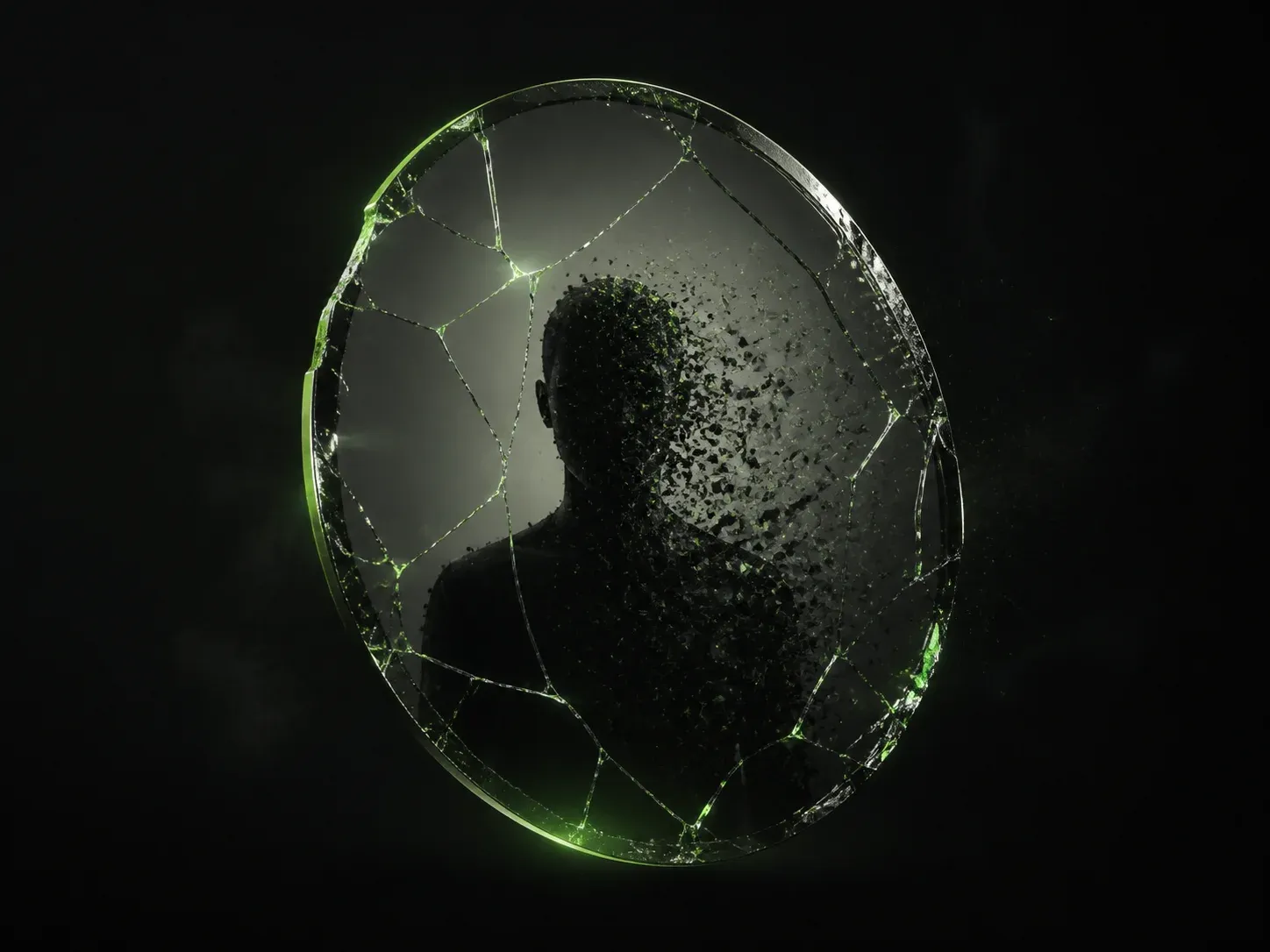
In the Mirror of the Machine
١٩/٨/٢٠٢٦
Homeland - Performance lecture by Dr. Ramia Gaafar and Artist Sameh Al Tawil, Cairotronica, May 2025
Toward a Posthuman Aesthetics of Artificial Intelligence
A Performance-lecture by Sameh Al Tawil at the October University for Modern Sciences and Arts (MSA) Faculty of Art & Design. Cairo – November 2025
Abstract
This lecture examines the emergence of artificial intelligence as both an aesthetic medium and a cognitive apparatus, and the need for a new, non-centralized understanding of the creative process—one that challenges Western models of artistic ownership. Drawing on postcolonial digital humanities, speculative realism, and postmodern aesthetics, I argue that AI art is not merely a technological development but an ontological shift requiring new frameworks for understanding creativity, cultural representation, and the politics of algorithmic mediation. Through a combination of self-reflexive artistic analysis, contemporary AI art case studies, and theoretical engagement with poststructuralist and decolonial philosophy, this text proposes a vision of AI development that preserves human cultural sovereignty while fostering genuine human–machine collaboration.
Keywords: Artificial Intelligence, Speculative Realism, Posthuman Art, Algorithmic Aesthetics, Creative Agency, Object-Oriented Ontology, Cultural Representation, Human–Machine Collaboration.
Introduction: When the Mirror Speaks
The discourse surrounding artificial intelligence in contemporary art often oscillates between techno-utopian celebration and dystopian anxiety. Yet the most urgent questions lie elsewhere: in the epistemic structures upon which these systems are built. When we shift our analytical focus from the results of AI art to its mechanisms, and from its outputs to its ontological nature, a complex field emerges—one in which questions of artistic agency, intellectual property, and cultural representation intersect with the material realities of algorithmic mediation.
This lecture argues that artificial intelligence is not simply a new tool in the artist's arsenal, but a profound disruption of Western conceptions of creative genius and individual authorship. More provocatively, I contend that AI art—when viewed through postcolonial and speculative realist lenses—reveals an accumulated epistemic violence embedded within computational systems, while simultaneously opening spaces for what I term "the decentralization of creativity": forms of artistic practice that distribute agency across human and nonhuman creators, challenging the Cartesian–Kantian logic of singular creativity that has dominated Western art discourse.
The metaphor of the mirror functions on multiple levels. AI systems are mirrors that reflect the cultural biases encoded in their training data; yet they are not passive mirrors. They are active reflectors: they dismantle, fracture, distort, and reconstruct the cultural material they encounter. Thus, AI art confronts us with what Lacan describes in the mirror stage—an encounter that is simultaneously one of recognition and misrecognition, where the self meets an image that is at once familiar and fundamentally alien.
Decentering the Artist: From Genius to Collectivity
The romantic notion of human artistic genius has long operated as both an aesthetic ideal and an ideological apparatus—one that reinforces hierarchies of cultural production while obscuring the collaborative, material, and contextual conditions that make artistic creation possible.
AI art radically challenges this model, not because machines can now "create," but because these systems foreground rhizomatic, networked, and collaborative aspects of creativity that have always existed yet remained marginalized.
Consider the work of artists such as Refik Anadol, whose Machine Hallucinations transforms massive datasets into immersive visual environments that blur the boundaries between human intention and algorithmic interpretation. Anadol's practice exemplifies what might be called the curatorial turn in AI art—a shift from direct creation toward designing the conditions under which creation emerges. The artist becomes less a maker and more a designer of constraints, a choreographer of human–machine encounters.
This collaborative model resonates strongly with longstanding critiques of Western individualism. Scholars such as Trinh T. Minh-ha have argued that the myth of the individual genius obscures the relational and collective dimensions of cultural production, particularly in non-Western contexts. AI art, by making nonhuman collaborators visible and necessary, opens fertile ground for aesthetic frameworks historically marginalized by Western institutions.
Speculative Realism and the Ontology of AI Art
The deeper challenge posed by AI is not the displacement of the artist, but the dismantling of the philosophical assumptions that place the human at the center of the creative universe. Speculative realism—especially its branch known as Object-Oriented Ontology (OOO)—offers a radical framework for understanding this shift. Rejecting what Quentin Meillassoux terms correlationism—the idea that reality can only exist in relation to human thought—speculative realism asserts the independent existence of all objects, whether human, nonhuman, conscious, or unconscious. From Graham Harman's perspective, every object—be it a person, a rock, a poem, or an AI system—possesses a withdrawn reality inaccessible to full comprehension. We encounter only its sensual caricatures. Applied to AI art, this yields several implications:
- The artwork as an autonomous object
The AI-generated artwork is not merely a reflection of human intent or training data, but a new entity with its own reality, irreducible to its parts.
- AI as an artist-object
The AI system operates as an active object with its own withdrawn reality—its latent space, probabilistic operations, and encoded biases shape the artwork in ways that escape human perception.
- Posthuman aesthetics
Beauty becomes a relation among objects—human and nonhuman—not merely a judgment imposed by a human subject. This shift moves us beyond the tedious question "Can machines be creative?" toward the far more generative inquiry: "What kind of object have we created, and how do we relate to it?"
Algorithmic Aesthetics and the Crisis of Kantian Judgment
The emergence of AI art fundamentally challenges Enlightenment aesthetics, particularly Kant's influential formulation of aesthetic judgment as grounded in the free play of imagination and understanding within a human subject. When faced with an AI-generated artwork, what exactly do we judge? The algorithm? The human intention? The data? The interplay among them?
Kantian aesthetics, built on a clear distinction between subject and object, collapses in the face of artworks whose very existence depends on forms of mediation surpassing individual consciousness. Speculative realism, by rejecting human centrality, enables us to understand the artwork not as an object judged by a transcendental subject, but as the site of a meeting among multiple objects and agencies.
Post-Digital Humanities and the Politics of Algorithmic Perception
AI-mediated cultural production cannot be understood apart from the broader context of what may be called digital coloniality. Most AI art systems are developed in the Global North, trained on datasets overwhelmingly shaped by Western cultural production. AI models that generate images of local cultural practices often reproduce harmful, stereotypical representations. Yet the same technologies that enable new forms of digital colonialism can also open pathways for what I describe as anti-colonial AI—provided we intervene in the processes of dataset construction, model training, and governance, and critically question who controls these systems and for what purposes.
Case Study: "Homeland"
My recent artwork "Homeland", developed in collaboration with Dr. Rania Gaafar (April 2025, Cairotronica symposium IV), attempts to build what might be called a non-colonial intelligent artistic agent. The project centers on the displaced bust of Queen Nefertiti—held in the Neues Museum in Berlin—as a virtual persona through which to explore the politics of cultural displacement. Rather than training an AI system to produce aesthetically pleasing images "inspired by Egyptian civilization," we constructed a virtual artifact—an intelligent agent trained not only on neutral datasets but on an archive of mourning and resistance. We asked: Can a machine grieve? Can technological systems become co-witnesses to human loss?
Speculative fiction - part of Sameh Al Tawil and Rania Gaafar's "Homeland" GenAi art project. Cairotronica 2025
My newer project, "Short Shadows", extends this inquiry, forming an entangled partnership with generative AI systems to construct an imaginary world where reality dissolves into fantasy and memory merges with hallucination. It materializes across multiple media—texts, sounds, images, music, video, live performance, and books.
Slave - Digital sculpture part of "Short Shadows" Art project by Sameh Al Tawil and the machine - 2025
Conclusion: Toward a Nomadic Ethics for AI Art
The mirror that AI art holds up to contemporary culture reveals not only new creative possibilities but also the contradictions and embedded violences of existing knowledge systems. The theoretical frameworks explored here—from Kantian critique to speculative realism—suggest the necessity of a more complex, contextual, and politically attuned understanding of AI art.
What I call a nomadic ethics of AI art offers an evaluative framework grounded in the real, material effects of these technologies on communities and cultural practices. It demands forms of cultural critique capable of engaging with the technical complexities of AI while remaining attentive to its political, social, and cultural dimensions.
At stake is not merely the future of art and culture—but the future of humanity itself in the age of artificial intelligence.
In the Mirror of the Machine - Performance Lecture by Sameh Al Tawil at MSA, 2025
Related link referenced in the original article: https://samehaltawil.com/portfolio/short-shadows/
Originally published on LinkedIn.